5 Cybersecurity Predictions for 2026
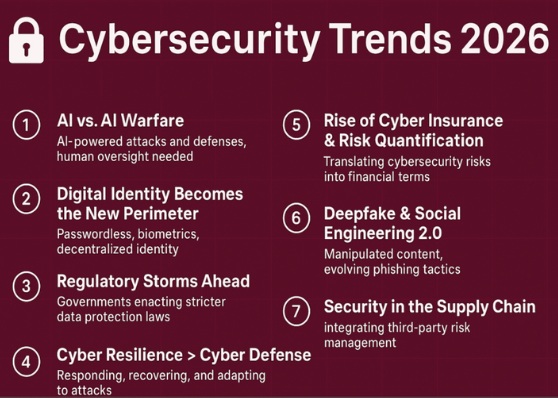
Security Magazine highlights five major trends that will redefine cybersecurity in 2026: AI-driven threats, quantum-safe encryption, Zero Trust mandates, supply chain security, and resilience as a business metric.
- AI-powered attacks and autonomous malware
- Quantum computing challenges for encryption
- Zero Trust adoption becomes mandatory
- Supply chain security under stricter regulations
- Cyber resilience as a board-level KPI

1. AI-Powered Attacks Will Escalate
According to experts, artificial intelligence will increasingly be weaponised by threat actors. Expect malware that learns and adapts autonomously, bypassing traditional detection methods. Attackers will use AI to automate phishing campaigns, generate convincing deepfakes, and exploit vulnerabilities faster than human defenders can respond. Defensive strategies must include AI-driven analytics and behaviour-based detection to keep pace.
2. Quantum Computing Will Disrupt Encryption
Quantum computing is expected to challenge current cryptographic standards. Algorithms like RSA and ECC could be rendered obsolete by quantum capabilities, making sensitive data vulnerable. Organisations should begin transitioning to quantum-safe encryption and explore NIST-approved post-quantum cryptographic algorithms to future-proof their security posture.
3. Zero Trust Will Become Non-Negotiable
Zero Trust principles—“never trust, always verify”—will move from best practice to regulatory requirement. With hybrid work and cloud adoption accelerating, identity-centric security will dominate compliance frameworks globally. Expect mandates for continuous authentication, micro-segmentation, and least-privilege access across all sectors.
4. Supply Chain Security Will Face Tight Controls
High-profile breaches have exposed the fragility of software supply chains. In 2026, expect stricter vendor risk assessments, mandatory SBOM (Software Bill of Materials) disclosures, and continuous monitoring of third-party components. Regulatory bodies will enforce transparency to reduce systemic risk.
5. Cyber Resilience Will Be a Board-Level KPI
Cybersecurity will no longer be seen as an IT issue alone. Boards will measure resilience metrics—such as recovery time, incident response maturity, and business continuity—alongside financial performance. Cyber resilience will become a key differentiator for investor confidence and regulatory compliance.
Reflective IT Tip
Start preparing now: adopt Zero Trust, explore quantum-safe encryption, and integrate resilience metrics into your business strategy.
Ready to Future-Proof Your Security?

Reflective IT can help you design a roadmap for 2026 and beyond. Contact us today to strengthen your defences and stay ahead of emerging threats.
📞 0207 317 4535 | 📧 support@reflectiveit.com