These days, cyber attacks are just part of doing business – and the UK is no exception. The government's latest Cyber Security Breaches Survey shows that 43% of UK businesses faced cyber attacks in 2024, with phishing hitting 85% of victim organisations. For medium and large businesses, each successful attack costs an average of £10,830 - which explains why more companies are turning to managed SOC providers for round-the-clock protection.

When it comes to cyber security, you either invest in prevention or pay for the consequences. Managed Security Operations Center (SOC) providers offer 24/7 security monitoring and incident response services, giving businesses access to enterprise-level protection without the massive overhead and delay of building their own security operations centers.
Most guides don’t tell you that picking the right managed SOC provider isn’t just about finding the best one. No - it's about finding the right fit for your organisation. A global enterprise solution that works perfectly for a 5,000+ employee multinational might be complete overkill (and overpriced) for a company 1/10 the size. And a budget provider might appear to tick all the boxes on paper but lack the industry expertise or response capabilities your business needs.
This is all to say that not all managed SOC providers are built the same. Some serve large enterprises, others focus on specific industries, and many simply don't understand the unique challenges facing UK SMEs. The trick is matching your organisation's size, sector, and security maturity with a provider that genuinely understands your world.
In this post, we’ll cut through the background noise to help you find a perfect match.
Check out our comprehensive guide to choosing the right outsourced SOC provider for your business.
What Are Managed SOC Providers
Let's get down to the basics. A Security Operations Center (SOC) is essentially the nerve center of an organisation's cybersecurity operations. It's where security analysts monitor networks, investigate threats, and respond to incidents around the clock. A digital command center of sorts.
The "managed" part just means you're outsourcing this entire operation to a specialist provider. Instead of hiring your own security team, building a SOC facility and maintaining expensive security tools, you partner with experts who already have everything in place. Your managed SOC service provider becomes your extended security team, watching over all your systems so you can focus on running your business.
Core Managed SOC Services
Most managed SOC providers offer these core services:
- Security monitoring: Continuous surveillance of your networks, endpoints, and applications using advanced tools like SIEM (Security Information and Event Management) platforms.
- Threat detection: Identifying suspicious activity, malware, and potential breaches before they cause serious damage.
- Incident response: If something goes wrong, your SOC team jumps into action to contain the threat and minimise impact.
- Threat hunting: Proactive searching for hidden threats that automated tools might miss.
- Vulnerability management: Regular scanning and assessment of your systems to identify security weaknesses.
- Forensic analysis: Deep-dive investigations into security incidents to understand what happened and prevent future attacks.
- Compliance reporting: Documentation and reports to help meet regulatory requirements like GDPR or industry standards.
At this point, it's important to know that the level of service can vary significantly. Some providers offer true analyst-led monitoring and response. Others provide more basic alert forwarding or tool management. That distinction matters when comparing managed SOC providers.
Managed vs In-House SOC Comparison
Building an in-house SOC is possible, but it is expensive and operationally demanding.
To operate properly, an internal SOC needs skilled analysts, security engineers, monitoring platforms, escalation procedures, documented processes, threat intelligence, out-of-hours cover and ongoing training. It also needs enough people to provide holiday cover, sickness cover and genuine 24/7 coverage.
For most SMEs and many mid-market organisations, that is difficult to justify. Even when there is an internal IT team, they are often already responsible for infrastructure, users, projects, suppliers, devices and day-to-day support. Asking the same team to provide continuous security monitoring can create gaps.
A managed SOC provider spreads the cost of analysts, tooling and processes across multiple clients. That gives businesses faster access to a mature security operations capability without having to build it from scratch.
In-house SOC may be right if:
- You are a large enterprise with complex global infrastructure
- You have the budget to recruit and retain specialist analysts
- You need total control over security operations
- You already have mature internal security governance
- You can support genuine 24/7 cover
Managed SOC may be right if:
- You need stronger monitoring but do not want to build a full internal SOC
- Your internal IT team is already stretched
- You rely heavily on Microsoft 365, Azure or cloud platforms
- You need faster threat detection and clearer escalation
- You want predictable monthly costs
- You need evidence for insurance, compliance or board reporting
Co-managed SOC may be right if:
- You have an internal IT or security team but need additional monitoring capacity
- You want to retain control over some decisions while outsourcing overnight monitoring or specialist response
- You need support tuning alerts and improving detection maturity over time
Why UK Businesses Choose UK-Based Managed SOC Providers
Location is not the only factor when choosing a managed SOC provider, but it can make a practical difference.
A UK-based provider is often easier to work with for reporting, escalation, meetings, legal alignment and business context. This is especially relevant for organisations handling sensitive client data, regulated information or professional services work.
Data handling and UK legal context
Under GDPR and UK data protection laws, businesses remain ultimately responsible for how personal data is processed. A provider based in the UK will be subject to the same legal jurisdiction as your business, making GDPR compliance simpler. If you're using an offshore provider, you risk vague data handling practices and little control over their practices. UK providers understand the nuances of UK privacy laws and often maintain data centers within UK borders.
Time zone and communication
Sure, managed SOC providers keep an eye on your systems 24/7, no matter where they are, but it's just easier to work with someone in the UK. Setting up meetings, going over reports, planning to make your security better, or getting updates on what's going on – it all goes smoother when your SOC team is working when you are.
Local threat context
UK-based SOC providers know what it's like to work with UK companies. They know the tricks people use to attack your industry and often talk to UK law enforcement. Knowing what's happening here helps them spot attack patterns in your area or industry that someone from another country might miss.
Culture and communication
It’s also important to not overlook the cultural element and communication nuances when you’re in a security scuffle, communication is critical. A UK based analyst understands the business culture in the UK and how to engage a complaint regulator and can speak plain English instead of technical language that may not have the same connotations across cultures and languages.
Often the advantages of working with a UK based SOC provider outweigh cost savings from alternatives. This is especially common for companies working with sensitive user data or operating in highly regulated industries like financial services, accountancy or law. The question isn't whether you save money - it's whether you get the right protection for your specific needs.

Types of Managed SOC Providers in the UK
The managed SOC market is not one single category. Different providers are built for different types of organisation.
Understanding those differences helps you avoid two common mistakes: paying for an enterprise-grade service you do not need, or choosing a low-cost service that cannot support you properly during a real incident.
Enterprise-focused providers
These include large global technology, consulting and cyber security firms. They typically have extensive SOC infrastructure, advanced tooling and experience supporting complex environments.
They are a good fit for large organisations with multinational operations, complex estates, heavy compliance requirements or advanced internal security teams.
For SMEs, the risk is that the service can feel too large, too expensive or too process-heavy. You may get access to impressive capability, but less direct attention.
SME-Specialist Providers
These providers are usually a better fit for organisations that need practical cyber security support but do not have a large internal security team.
The benefit is often closer communication, more flexible support and a better understanding of real-world SME constraints. You are more likely to speak to people who understand your environment, rather than being routed through a generic enterprise support process.
For Reflective IT, this is the strongest fit: organisations that want managed SOC support alongside managed IT, managed security, incident response and cyber resilience.
Technology Vendor SOCs
Microsoft, for example, offers security services built around their ecosystem. If you're heavily invested in Microsoft 365 and Azure, this approach can make sense.
The integration is usually seamless, and pricing can be attractive when bundled with existing licenses. But you're essentially putting all your security eggs in one vendor's basket. What happens when you need tools or perspectives they don't offer?
Hybrid/Co-Managed Options
Some organisations keep internal ownership of security strategy while outsourcing monitoring, triage or out-of-hours response.
This can work well where there is an internal IT team that wants expert support without handing everything over.
Key Questions to Ask Managed SOC Providers
This is where things get real. Anyone can make a fancy sales pitch, so you need to ask the right questions to find the providers who can really do the job. Don't be afraid to ask a lot – you're trusting these people with your security.

Team and Enterprise Questions
- What certifications do your SOC analysts hold? You want to hear about CISSP, GCIH, SANS certifications, and other recognised security credentials.
- What's your average analyst experience level? This reveals whether you're getting seasoned professionals or recent graduates learning on your infrastructure.
- Do you provide a dedicated account manager? Some providers rotate whoever's available. Others assign specific team members who learn your business inside out.
Tech and Capabilities Questions
- What SIEM and security tools do you use? Their answer should include well-known platforms like Sentinel, QRadar, or Splunk, along with details about threat intelligence feeds and detection capabilities. If they're vague about their technology stack, that's a red flag.
- How do you integrate with our existing security stack? Your new SOC shouldn't exist in isolation. They need to work with your current firewalls, endpoint protection, and other security tools. Ask for specific integration examples.
- What threat intelligence sources do you leverage? Quality threat intelligence separates good SOCs from great ones. They should use multiple commercial and open-source feeds, plus have relationships with industry groups and law enforcement.
Service Level and Process Questions
- What are your guaranteed response times? Critical alerts should trigger immediate response but make sure their definition of "immediate" matches yours. Some providers consider four hours "immediate" - others mean five minutes.
- How do you handle escalation procedures? When something serious happens, you need clear escalation paths. Who gets involved and when? How do they communicate with your team?
- What reporting do you provide and how often? Monthly summaries are standard, but you might need weekly tactical reports or real-time dashboards. Make sure their reporting schedule matches your needs.
- How do you manage false positives? Every SOC generates some false alarms. The question is whether they fine-tune their systems to reduce noise over time or just keep forwarding everything to you.
Managed SOC provider pricing models
Talking about prices with SOC providers can get confusing fast. Everyone seems to do it differently, which makes it hard to compare. Here are some of the most common pricing plans:
Per-User Pricing Models
The simplest approach - you pay a monthly fee for each person in your organisation. It's straightforward for budgeting, and you know exactly what happens when you hire someone new or when people leave.
This works well for companies where everyone needs roughly the same level of security coverage. The downside comes when you've got a mixed workforce - why should the part-time bookkeeper cost the same to monitor as your IT director with admin access to everything?
Per-Device/Endpoint Pricing
Here, every laptop, server and phone gets its own price tag. Some providers love this model because they can charge different rates for different device types - servers cost more than basic workstations.
It makes sense if you've got lots of devices per person or a bring-your-own-device culture. But tracking everything becomes a real headache, especially when people swap equipment or you're constantly adding new IoT devices.
Tired Service Models
Most providers offer packages like "Bronze" "Silver," and "Gold" You get different levels of monitoring depth, response speed, and analyst attention based on which tier you choose.
The tricky bit is figuring out what you actually get at each level. One provider's "Silver" might be another's "Bronze" with fancy marketing names. Just make sure to ask what changes between tiers.
Bespoke Pricing
Sometimes none of the standard models fit. Maybe you need special compliance features, have legacy systems requiring extra attention, or want different service levels for different parts of your business.
Custom pricing offers flexibility but makes comparison shopping impossible. You're basically negotiating a unique deal every time, which can work in your favour or against it depending on your negotiation skills.
Our advice would be to not get too hung up on which pricing model a provider uses. Focus on understanding exactly what you're getting for your money and whether it matches your actual security needs.
SLA and Performance Metrics That Matter
Service Level Agreements sound boring and we're not going to tell you otherwise. But when something goes wrong, they become the most important document you've signed. Here are some of the things to watch out for:
Response time commitments
Critical security incidents should trigger immediate human review, not just automated acknowledgment. High-priority alerts warrant response within 15-30 minutes, while medium-priority issues could take a few hours.
Watch out for providers who define "response" as sending an automated email. Real response means a qualified analyst investigates and communicates findings back to you.
Resolution and Communication Processes
Resolution timeframes should reflect reality. Some SLAs promise unrealistic resolution times that force analysts to close tickets prematurely. Better providers focus on communication commitments - keeping you informed rather than rushing to hit arbitrary deadlines.
Reporting and Escalation Procedures
Reporting frequency needs to match your needs - monthly executive summaries, weekly operational reports, or real-time dashboards. Make sure your SLA specifies exactly what reports you'll receive and when.
The best SLAs include escalation procedures with clear paths for involving senior analysts when things go sideways.
Compliance and Certification Requirements
You should be working with a provider who understands your regulatory landscape. The stakes are too high to get it wrong. If you do, you'll be explaining to auditors why your SOC provider doesn't meet requirements.
GDPR and Data Processing
GDPR is at the foundation of any UK business. Your SOC provider processes personal data during monitoring, making them a data processor under GDPR. They need proper data processing agreements, clear retention policies, and documented security measures.
Essential UK Certifications
Cyber Essentials certification has become baseline for UK government work, with many private organisations now expecting it. Cyber Essentials Plus offers additional assurance through hands-on technical verification.
ISO 27001 certification indicates serious commitment to information security management with ongoing processes, regular audits, and continuous improvement. Providers with ISO 27001 tend to have more mature security practices.
Industry-Specific Standards
Industry-specific requirements add complexity. Financial services need FCA-familiar providers. Insurance companies want Solvency II understanding. Manufacturing might need industrial cybersecurity standards.
Third-Party Audit Reports
SOC 2 Type II reports provide detailed insight into provider control environments through third-party audits examining customer data protection and system availability over time.
Don't assume certifications guarantee good service - they're minimum qualifications, not performance indicators. But missing relevant certifications often signals providers who don't understand your industry or haven't invested in proper governance.

Technology Integration Requirements
Your SOC provider needs to fit your existing technology environment, not replace everything. Integration complexity often catches businesses off guard, so make sure not to get caught out.
SIEM and Security Tool Integration
SIEM platform compatibility determines visibility across your infrastructure. Firewalls, endpoint protection, email security, network monitoring - all need to feed information into SOC monitoring systems.
Microsoft ecosystem compatibility
Microsoft ecosystem integration deserves special attention since many UK businesses rely on Microsoft 365 and Azure. These platforms generate massive security telemetry but interpreting it requires genuine expertise. Providers with deep Microsoft knowledge understand alert tuning, recognise suspicious Azure AD activity, and leverage features you're already paying for.
Network Access and Connectivity
Some providers need VPN connections, others work through API connections and cloud integrations. Modern approaches favour API-based connections – they're often more secure and easier to manage than network tunnels.
Endpoint agents are another consideration. Will you install new monitoring agents on every device? How do these interact with existing endpoint protection? Some providers work with current tool data, others require their own software deployment.
Multi-cloud platform support
Cloud platform compatibility becomes critical for multi-cloud environments. Your provider should handle hybrid setups without separate monitoring solutions. The goal is unified visibility, not multiple dashboards.
Top 10 Managed SOC Providers in the UK
The providers below are grouped by likely buyer fit. The right choice depends on the size of your organisation, the complexity of your environment, your internal security maturity and how much hands-on support you need.
SME & Mid-Market Managed SOC Providers
1. Reflective IT
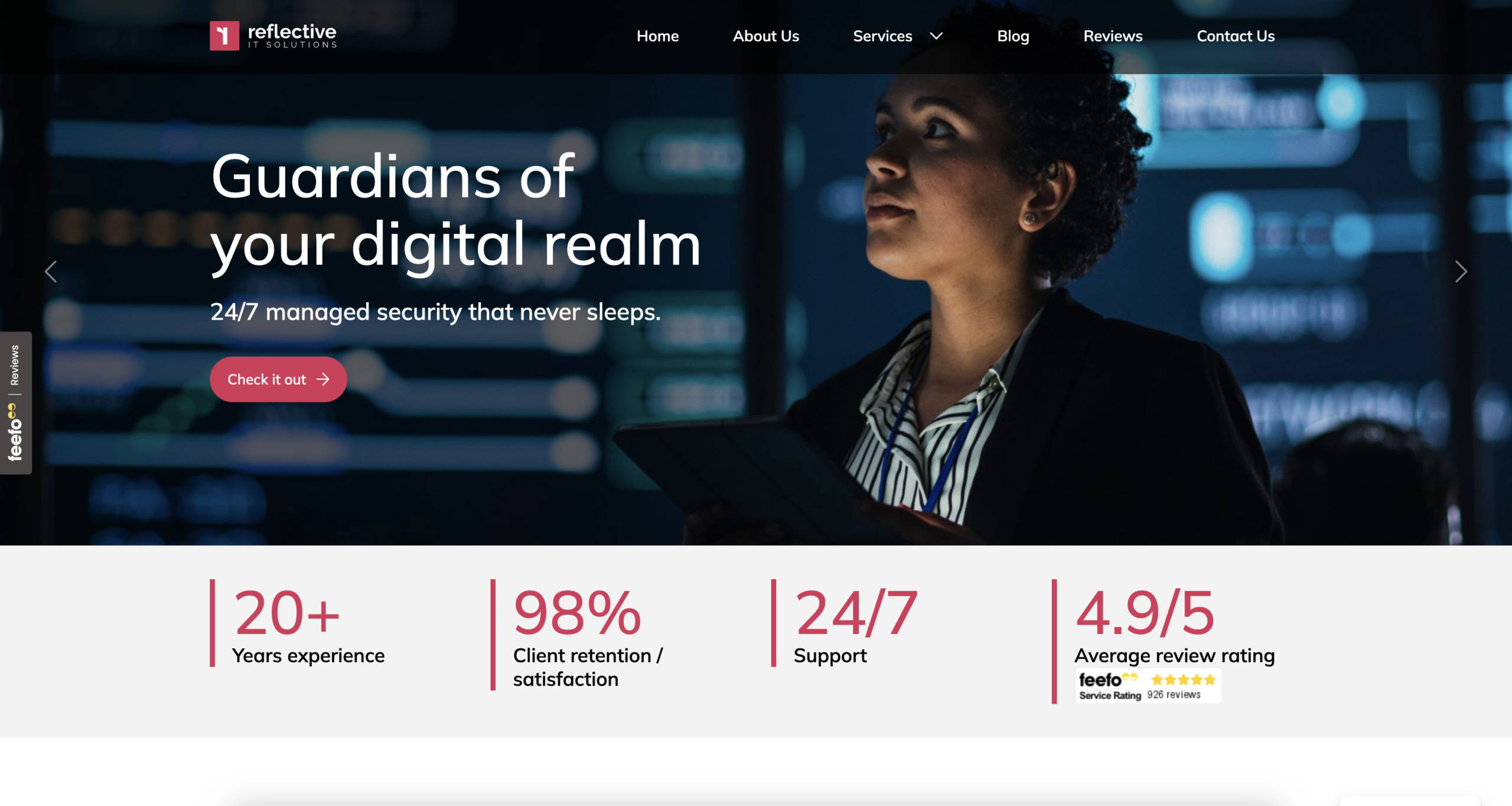
We’ve been helping UK businesses secure and manage their IT for over 20 years. Our managed SOC service is built for organisations that want peace of mind and straightforward protection without layers of red tape. With 4.9/5 verified ratings on Feefo from our clients, we’re proud of the reputation we’ve earned for reliability and personal service.
As your SOC partner, we don’t just monitor alerts - we actively hunt threats, investigate incidents, and guide you through response and recovery. And because we offer a full suite of complementary security services, including Incident Response Services and Disaster Recovery & Backup, you get complete coverage from a single trusted partner.
Best fit: SMEs and growing organisations that want practical, joined-up SOC and managed IT support from one partner.
2. Redscan
A well-established UK MSSP, now part of Kroll. Redscan’s SOC services include MDR, SIEM management, and penetration testing. They are particularly strong on compliance reporting and helping mid-sized businesses reduce false positives through tailored threat detection.
Best fit: Mid-market organisations looking for specialist MDR and managed security capability.
3. Evalian
Evalian offers SOC-as-a-Service alongside advisory and compliance support. Their SOC covers 24/7 monitoring, incident response, and threat hunting, and they might be useful for businesses that also need guidance with GDPR, ISO 27001, and Cyber Essentials. The trade-off is that Evalian leans more towards consultancy, so SOC services may not feel as central to their business as with pure-play MSSPs.
Best fit: Organisations that want managed SOC alongside compliance, advisory or certification support.
4. Nomios

An international MSSP with a UK presence. Nomios provides SOC services across networks, endpoints, and multi-cloud environments. Their approach emphasises strong governance and clear onboarding, making them suitable for mid-market businesses with diverse or hybrid IT estates. They’re less “boutique” than providers like Reflective, but scale well for larger SMEs.
Best fit: Mid-market organisations with network, cloud or hybrid infrastructure complexity.
5. LittleFish
LittleFish is a UK-based managed IT and security provider. Their managed SOC offering delivers continuous monitoring and incident response, with a big focus on accessibility and customer support. They’re a decent fit for SMEs that want to combine SOC with broader managed IT services.
Best fit: SMEs wanting managed IT and security support from one provider.
6. UBDS Digital

London-based SOC provider offering 24/7 coverage with AI-driven detection tools and SC/DV cleared analysts. They’re strong in government and public sector projects but less widely known in the SME private market.
Best fit: Public sector, regulated or security-conscious organisations that need strong operational security capability.
Enterprise-Focused Managed SOC Providers
These providers are good options for large organisations with exceptionally complex infrastructure, multinational operations, or strict compliance requirements.
7. BAE Systems Applied Intelligence

One of the UK’s most established cyber defence companies, BAE Systems provides SOC services for government, defence, and critical national infrastructure. Their strength lies in deep threat intelligence and experience handling nation-state level threats. For SMEs, however, their services are usually too complex and costly.
Best fit: Government, defence, critical infrastructure and large enterprise environments.
8. IBM Security
IBM operates a global network of SOCs and offers MDR, SIEM management, and advanced threat intelligence. Their scale means they can handle extremely large and complex environments. The downside: long onboarding times and less personalised service for smaller customers.
Best fit: Large enterprises needing global SOC capability.
9. Atos
A global IT and digital transformation leader with a strong SOC practice in the UK. Atos is often chosen by enterprises already using them for infrastructure or cloud services. Their strength is in bundling SOC with large-scale IT outsourcing, though this can make their offerings less flexible for standalone SOC buyers.
Best fit: Large organisations wanting SOC services integrated into broader IT outsourcing or transformation programmes.
10. Capgemini

Capgemini combines SOC services with consulting and systems integration, making them attractive for enterprises undergoing large digital transformation projects. Their governance and compliance frameworks are robust, but smaller businesses may find their approach too heavy and expensive.
Best fit: Enterprises needing SOC capability as part of a wider transformation or managed services programme.
Getting Started with Managed SOC Providers
Choosing a managed SOC provider is a resilience decision, not just a cyber security purchase.
The best starting point is to define the outcome you need. For some businesses, that might be faster incident response. For others, it may be better visibility across Microsoft 365, stronger cyber insurance evidence, improved compliance reporting or reassurance that alerts are being reviewed around the clock.
Once you know the outcome, it becomes easier to choose the right type of provider:
- SME-focused managed SOC provider
- Pure-play MSSP or MDR provider
- Enterprise SOC provider
- Consultancy-led provider
- Co-managed SOC partner
For many UK SMEs, the strongest fit is a provider that combines practical SOC monitoring with managed IT, Microsoft security, incident response and resilience support. That is where Reflective IT can help.
If you want to understand whether managed SOC is the right fit for your organisation, speak to Reflective IT about our Security Operations Centre services. Get your free SOC consultation.
FAQs
How much does a managed SOC provider cost in the UK?
Managed SOC pricing varies depending on the size of your organisation, the number of users or devices being monitored, the complexity of your environment, the level of analyst support required and whether incident response is included.
Some providers charge per user, others charge per device or endpoint, and some use tiered packages. When comparing costs, focus on what is included rather than the headline price. A lower-cost service may only include basic alerting, while a more complete managed SOC service may include human triage, reporting, threat hunting and escalation support.
How long does implementation take?
Most providers complete onboarding in a matter of weeks. A typical process includes assessment, tool deployment, configuration, and full 24/7 monitoring. Complexity and existing systems will affect the exact timeline.
What’s the difference between a managed SOC and an MSSP?
A managed SOC provider focuses on security monitoring, detection, alert triage and incident response. An MSSP, or Managed Security Service Provider, may offer a wider range of security services such as firewall management, vulnerability scanning, compliance support and endpoint protection.
The two categories often overlap. Many MSSPs include SOC capability, and many managed SOC providers offer broader security services. The important question is how deep the provider’s monitoring and response capability is.
If you want to compare broader managed security service providers, not just SOC-focused partners, read our guide to the top managed security service providers (MSSPs) in the UK.
Do I still need an internal security team if I use a managed SOC?
It depends. SMEs often outsource security operations entirely, while enterprises may keep an internal team for governance and escalation. Some providers also offer co-managed SOC models, where responsibilities are shared.
Can I terminate a managed SOC contract early?
Contract flexibility differs by provider. SME-focused SOCs often offer shorter terms, while enterprise providers may require multi-year commitments. Always review contract conditions carefully.
How quickly do managed SOC providers respond to incidents?
Response times vary. Great providers guarantee immediate human triage for critical alerts, while others define “immediate” more loosely. Look for clear SLAs that outline times for critical, high, and medium alerts.
How do managed SOC providers handle GDPR and UK data privacy?
UK-based managed SOC providers must comply with GDPR and UK data protection law. They typically keep data in UK data centers and follow strict processing agreements. If considering offshore SOCs, confirm exactly where your data is stored and how it’s managed.